

Quick answer: Brands producing Limited Edition apparel Virginia collections can protect cash flow by testing demand with short Micro-runs, applying a 2.5× margin formula, and arranging multiple graphics onto shared Gang sheets to cut print costs.
Limited Edition apparel Virginia: testing demand with Micro‑Quantity orders
Order twenty transfers before committing to five hundred garments. Press them onto blanks, show them to your core buyers, and measure real sales. Micro-testing gives you verified purchase data before you commit serious working capital.
Screen printing historically boxed small Brands out of capsule Drops. High setup charges, screen-burning fees, and steep minimums made short runs a losing bet financially. Direct-to-Film (DTF) printing strips those roadblocks away. Because digital files print directly onto film with automated white-ink backing and adhesive powder, you can order single-digit or double-digit quantities without paying penalty rates for short runs.
Step‑by‑step Micro‑Quantity test
- Pick three primary concepts you want to test.
- Order 10 × 10 cm transfers for each graphic through DTF Transfer services.
- Press a short test batch of 20 to 30 units per design on your chosen garment style.
- Offer the batch on Instagram, Facebook, or at a local pop-up shop for seven days.
- Track unit sales, marketing costs, and customer feedback.
- Establish a pass/fail line: if 12 of the 30 shirts sell within that week, advance the design to full production.
Most Virginia shops can Run this test for under $150. Keep the test window brief to preserve customer urgency.
Pay attention to buyer notes during the test. Customers will tell you if they prefer an oversized back print over a small chest pocket hit, or if a particular tee blank feels too heavy. Adjust your final Gang Sheet layouts using that input before buying blanks in bulk.
Micro-Quantity testing validates real demand before you commit your working capital.
How to price Limited drop for maximum margin
Pricing Limited apparel Drops requires balancing genuine exclusivity against steady unit margins. A straightforward three-tier Pricing framework keeps your numbers Profitable:
1. Base cost calculation: Total your garment blank, DTF transfer, labor, and inbound shipping. Premium transfers from DTF Nova average $3.50 each, while an entry blank runs roughly $2.00.
2. Margin multiplier: Multiply that base cost by 2.5×. This covers drop marketing expenses and bakes in a healthy profit cushion.
3. Psychological price point: Round up to the nearest $5 or $10 mark to give buyers a clean number at checkout.
Here is how the math works: a $5.50 combined cost multiplied by 2.5 equals $13.75, which rounds cleanly to $15.00. That structure locks in a 70% gross margin while sitting well below the $45 average retail spend for premium graphic tees reported by Online fashion market statistics (Statista).
The multiplier formula handles heavier items just as easily. A heavyweight French terry hoodie blank might Run $18.00, with a large back-print transfer adding $6.00, bringing base costs to $24.00. Applying a 2.5× to 3.0× multiplier sets the target retail price between $60.00 and $72.00. Rounding to $65.00 or $70.00 hits expectations for premium streetwear.
A 2.5× margin multiplier paired with clean price rounding keeps Drops Profitable across every garment weight.
Garment blank selection and heat press optimization
Capsule quality rests on the blank you select. DTF transfers bond to 100% cotton, polyester, canvas, nylon, and blends without the strict ring-spun cotton requirements of direct-to-garment (DTG) printing.
Consistent heat press settings guarantee commercial wash resistance and a clean hand feel:
- Pre-pressing: Press the bare garment for 5 to 7 seconds at 300°F to 320°F (150°C to 160°C) to push out trapped fabric moisture and flatten stray surface fibers.
- Primary press: Position your transfer on the garment and press with firm pressure (around 60 psi or 4 to 5 bar) for 12 to 15 seconds.
- Peel technique: Let cold-peel films cool down fully before peeling. For hybrid hot-peel films, peel in a single smooth pull while the garment stays warm.
- Post-press finishing: Cover the print with silicone finishing paper or parchment and press for another 5 to 7 seconds. This seats the melted adhesive deep into the textile weave and leaves a matte finish.
Dialing in specific press temperatures and finishing steps ensures long-term wash durability on every piece.
Building mixed‑design Gang sheets for cost‑effective production
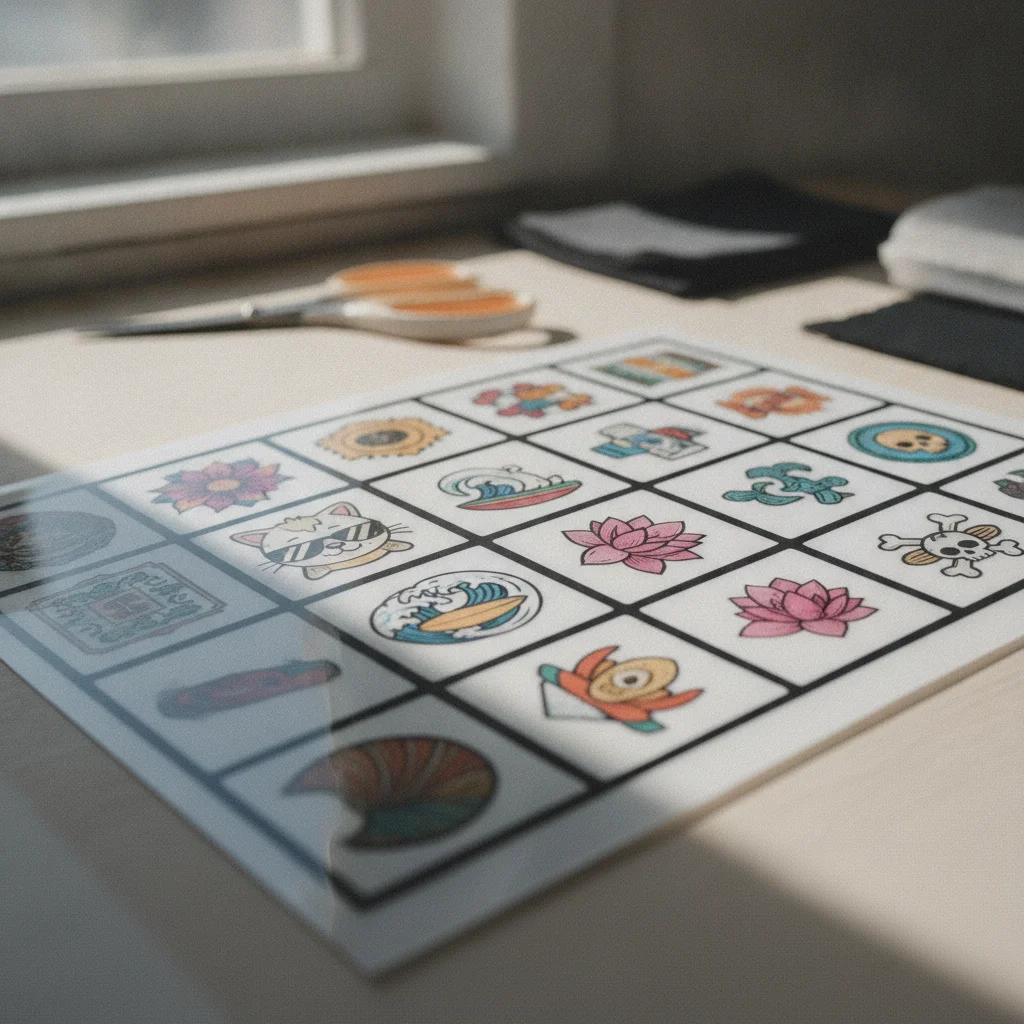
Gang sheets let you group several graphics onto a single continuous roll of film before cutting them apart. You Run the print job once, eliminating wasted film space and cutting transfer fees by roughly 30% compared to single-image orders.
To prep an efficient Gang Sheet:
- Collect every graphic intended for your drop.
- Arrange them on a fixed artboard (such as a 4 × 6 grid on a 30 × 40 cm Sheet).
- Leave at least 2 cm of spacing between artwork edges so shears cut cleanly.
- Upload your composite file to DTF Nova and tag it as a Gang Sheet in your production notes.
- Cut individual designs apart with a precision rotary trimmer or cutting ruler.
Take advantage of empty gaps between large graphics. Nest inside-neck prints, sleeve badges, hem tags, and hat designs into the open corners between major chest prints. Those bonus branding pieces print at zero added film cost.
Consolidating graphics onto mixed-design Gang sheets lowers unit costs and maximizes usable film area.
Hypothetical 4-week timeline for a Limited apparel release
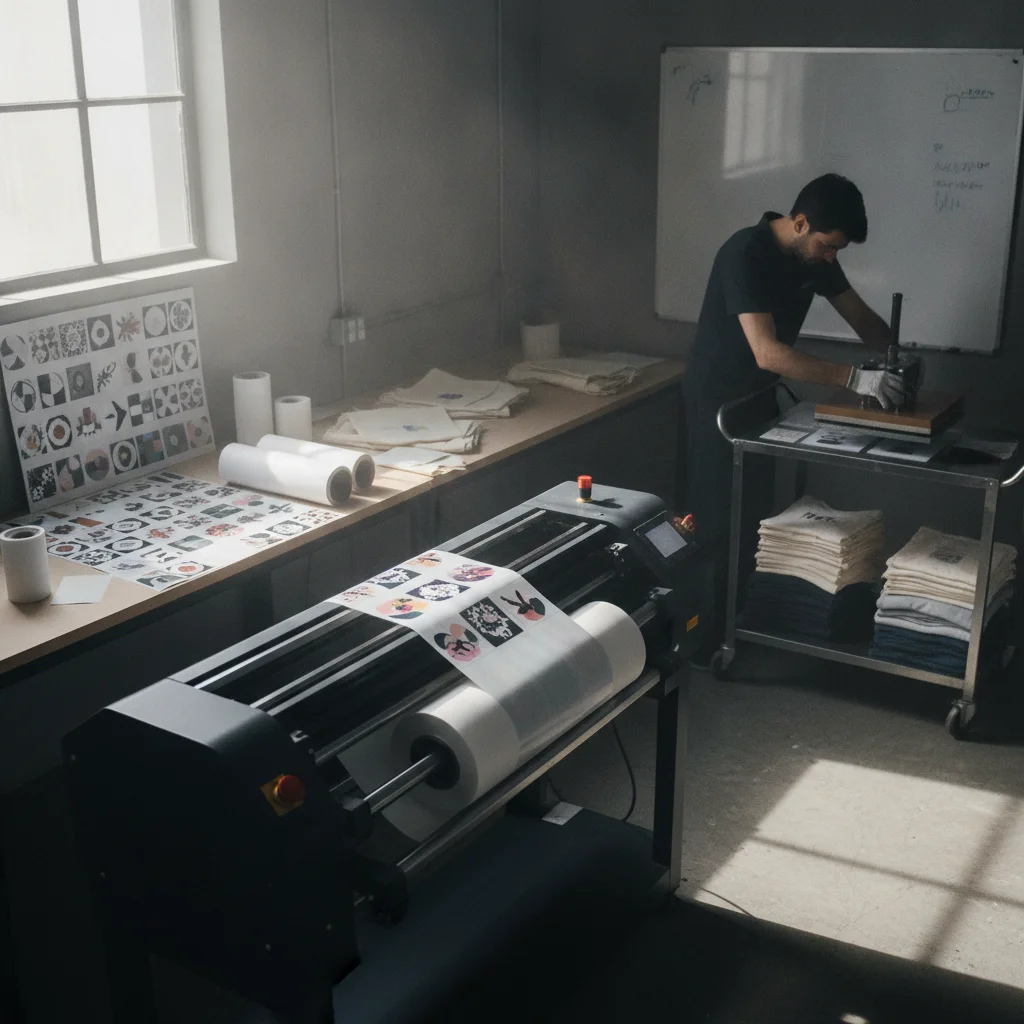
Unplanned releases lead to missed dates and dead inventory. Follow this four-week timeline to keep capsule launches organized:
- Week 1 (Design & Pre-flight): Build 300 DPI vector files with transparent backgrounds in CMYK format. Nest the graphics onto Gang sheets, submit the order, and purchase sample blanks in your target color options.
- Week 2 (Sampling & Micro-Testing): Press your initial samples. Shoot mockups on local models. Run Micro-orders with your VIP buyers or email subscribers to confirm popularity for each colorway.
- Week 3 (Teasers & Countdown): Announce the launch date, exact inventory cap (such as 100 pieces total), and ordering window. Share short pressing clips and detail shots to highlight fabric quality.
- Week 4 (Drop Day & Fulfillment): Launch sales online. As orders arrive, heat-press your blanks using pre-trimmed transfers. Pack and ship orders within 48 to 72 hours.
A disciplined four-week schedule prevents fulfillment logjams and builds genuine launch anticipation.
Real‑world example: a Virginia streetwear brand
A streetwear label out of Charlottesville planned a capsule drop called "River City" and applied this operational system:
- Micro-test: Printed 15 shirts per graphic; 80% sold out within five days.
- Pricing: Calculated a $5.20 base cost, added the 2.5× markup, and settled on a $15 retail price.
- Gang Sheet layout: Packed four designs onto one Sheet, saving $0.90 per transfer.
The drop brought in $4,500 in gross revenue at a 68% profit margin. The team used that return to finance their summer drop while growing their email subscriber list by 12%.
Capping production protected them against unsold stock. Extra blank tees were stored for upcoming capsules, and uncut transfers went into sealed storage bins for restocks and promotional giveaways.
Validating demand early protects operating capital and keeps dead stock out of your workspace.
Next steps – request your free sample pack
Test the print quality on your own garments before rolling out your next release. Head to the DTF Nova Blog and request a sample pack. We will print a custom Gang Sheet, slice the transfers, and mail them straight to your door.
Checking color vibrancy, stretch recovery, and adhesive grip in your shop lets you finalize design placements and retail Pricing with total clarity.
Frequently Asked Questions
How many designs should I include on a Gang Sheet? Stick to 4 to 8 designs per Sheet. That range balances film efficiency with easy manual cutting.
What is the ideal test batch size? A batch of 20 to 30 shirts per design provides clear sales feedback without leaving you with excess stock.
Can I use the same Pricing formula for accessories? Yes. Combine your base materials and transfer costs, apply the 2.5× multiplier, and round to an even dollar amount.
What artwork file format is best for Gang sheets? Submit vector PDFs, high-resolution PNGs at 300 DPI, or TIFF files with transparent backgrounds. Save all assets in CMYK to keep printed tones true to your screen proofs.
How long do unpressed DTF transfers last in storage? Stored flat in a cool, dry room away from humidity and direct sunlight, unpressed transfers remain fully usable for up to 12 months.
Can DTF transfers be applied to fleece, denim, and hats? Yes. DTF transfers bond cleanly to cotton, polyester, denim, poly-blends, nylon, and structured hat panels using standard flat platens or dedicated cap presses.
How should customers care for Limited Edition DTF apparel? Tell buyers to turn the garment inside out, wash in cold water on a delicate cycle, skip bleach and fabric softeners, and tumble dry on low heat or line dry.