

Your per unit cost DTF drops sharply the moment you spread fixed setup and labor across a packed sheet. When you separate raw film, ink, press time, overhead, and shipping into distinct buckets, you can price jobs accurately before taking on an order. Here is a practical unit-economics model, clear numbers for 25, 100, and 500-piece runs, and a spreadsheet template you can adapt right away.
Why Virginia apparel brands should build a gang‑sheet cost model
Gang sheets cut unit costs by pooling consumables and setup time across several prints at once. Instead of running single transfers and throwing away excess material, you gang multiple graphics onto one roll. For local Virginia shops balancing quick turnaround runs with product variety, this setup gives you the strongest lever to trim variable spend without sitting on unsold inventory.
Building a gang‑sheet model forces you to separate fixed from variable costs so pricing decisions are precise.
What is the per unit cost DTF for a gang sheet run?
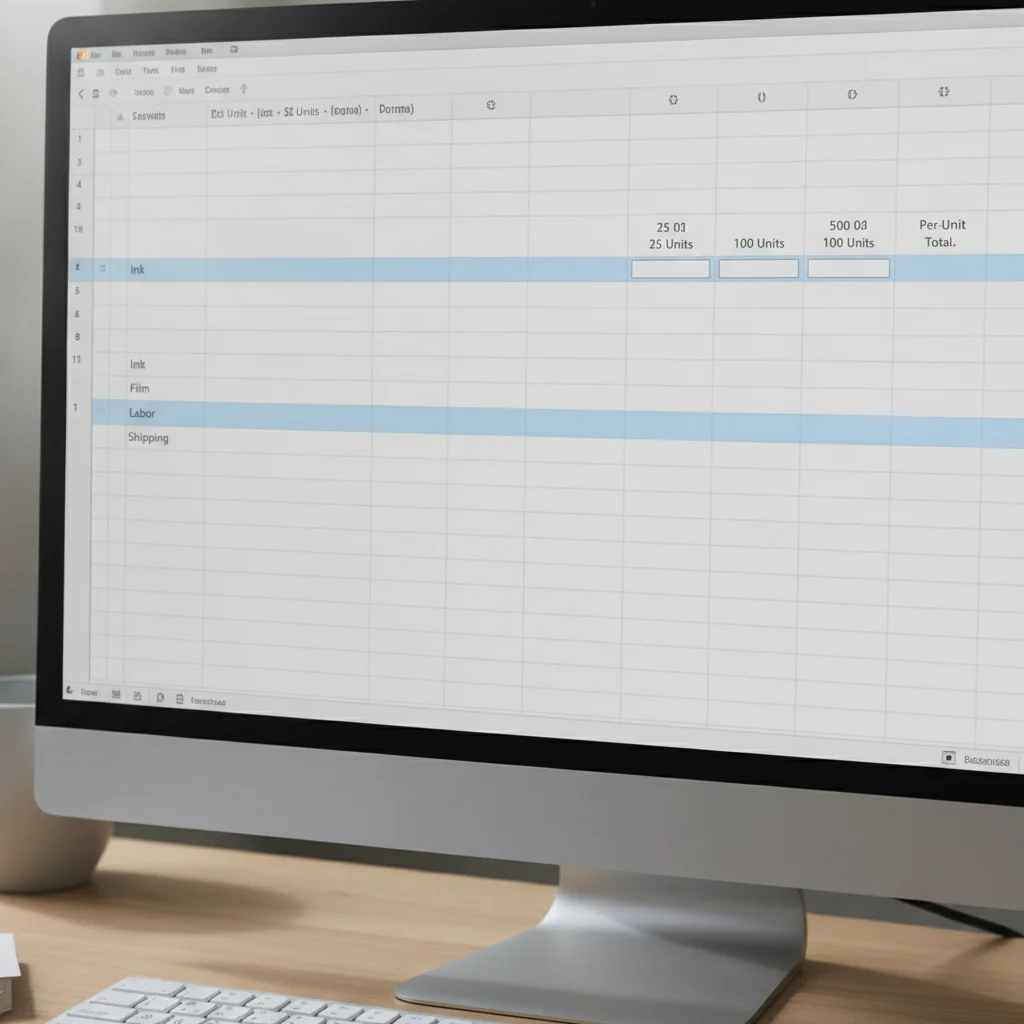
To find your true unit cost, take your fixed setup pool, divide it by the total units printed, and add the direct variable costs per piece. You don't need complicated accounting software to do this; a clean spreadsheet layout does the job for any batch size.
Use one clear formula at the top of your sheet and never mix fixed setup spend into variable cost lines.
Step‑by‑step model you can implement now (exact steps)
- List line items: ink consumption per sheet, film per sheet, transfer film waste factor, labor minutes per sheet, shipping per sheet, and a fixed setup allotment for the press run. Keep lines separate.
- Choose measurement units: track film by sheet area or sheet count, ink by grams or drops, and labor in minutes. Consistency matters here.
- Calculate sheet capacity: determine how many transfers fit on one gang sheet. Treat this count as your core design constraint.
- Compute fixed points: group setup time, press prep, and fixed consumables into a single pool labeled FixedPoints, which you will divide across total units.
- Compute variable points per sheet: track InkPoints, FilmPoints, LaborPoints, and ShippingPoints. You can convert dollars into internal points to test the math without sharing pricing openly.
- Apply the formula: Per‑Unit Points = (FixedPoints / Units) + (VariablePoints per sheet / transfers per sheet). Use the resulting number to set your markups.
- Set thresholds: if LaborPoints exceed 20% of Per‑Unit Points, streamline the floor workflow or raise your minimums. If FixedPoints divided by Units tops 30% of your Per‑Unit Points on target jobs, add a setup fee or require larger runs.
Follow these exact counting and conversion steps in your spreadsheet so your per‑unit estimates are repeatable.
Spreadsheet example (worked models for 25, 100, 500 runs: example numbers shown as cost points, not prices)
The tables below use abstract cost points instead of cash amounts. Points demonstrate how costs scale without locking you into specific market rates. Once you plug your actual supplier costs into the template, the sheet generates your real unit numbers.
| Line item | Per Sheet Points | Transfers per Sheet |
|---|---|---|
| InkPoints | 120 | - |
| FilmPoints | 80 | - |
| LaborPoints (per sheet) | 90 | - |
| ShippingPoints (allocated) | 30 | - |
| VariablePoints per sheet | 320 | - |
| FixedPoints (setup pooled) | 3000 | - |
Assume transfers per sheet = 5. Then per‑unit points = (FixedPoints / Units) + (VariablePoints per sheet / transfers per sheet).
| Run size | Units | FixedPoints/Unit | VariablePoints per unit | Total Per‑Unit Points |
|---|---|---|---|---|
| Example A | 25 | 120.00 | 64.00 | 184.00 |
| Example B | 100 | 30.00 | 64.00 | 94.00 |
| Example C | 500 | 6.00 | 64.00 | 70.00 |
The numbers above are points for illustration only. Replace point values with your actual currency in the template to produce real per-unit prices. Notice how FixedPoints per unit plunge from 120.00 down to 6.00 as volume grows from 25 to 500 transfers. Variable costs stay flat at 64.00 per unit, while your overhead spreads across the entire run.
How will a 25, 100, or 500 run change my per‑unit costs?
Short runs bear the full weight of your fixed setup. Long runs dilute that setup across hundreds of pieces until it barely registers. If a Virginia apparel client orders below your break-even threshold, protect your margin with a base setup charge or guide them toward standard prebuilt gang sheets.
Small, frequent SKUs demand either higher per‑unit pricing or enforced minimums; gang sheets let you lower that threshold.
Margin setting: exact percentages and decision criteria

Decide on your target margin first, then work backward to your selling price. For apparel blanks and transfers, your gross margin needs to comfortably cover press operations and customer acquisition.
- Rule A (catalog SKUs): Set a target gross margin percentage and calculate retail price as cost / (1 - margin%).
- Rule B (custom DTF transfers): Apply a direct markup multiplier (such as 2.0x) to your per-unit points, adjusting slightly between wholesale and web retail.
- Decision criteria: If FixedPoints per unit account for more than 25% of total per-unit cost on an average job, enforce a run minimum or bill a setup fee on an upfront line item.
Pick one pricing approach and keep it consistent across similar order types so you can compare margin performance.
Common mistakes and trade‑offs we've seen
Most margin leaks happen before the film touches the heat press. Shops routinely fold setup time into general unit costs, underestimate labor minutes, or disregard film waste altogether. Prep work and layout trimming eat into profit fast on short runs. Track labor by the minute, and factor in at least one extra film sheet per gang run as an explicit buffer against scrap.
Track labor minutes and film waste explicitly; they are the most common invisible cost leaks.
How to get the spreadsheet and a free sample pack
Grab the calculator template, enter your shop rates, and run a sample pack to check film release and ink durability before quoting live work. The template already includes the formulas above alongside slots for local labor rates, substrate costs, and ink weight. Use real test samples to fine-tune transfer density and gang sheet layouts ahead of production runs.
Download the template and test one sample gang sheet before you quote live orders.
Get the calculator and a custom gang sheet workflow via our Build your own DTF gang sheet page, and check turnaround and fulfillment details on the DTF Nova pricing page. Learn the basics of the technology on Direct-to-film (DTF) printing Wikipedia, and if you're planning business-wide cost tracking, compare this approach with the SBA's guidance at the SBA guide to calculating startup costs.
Frequently Asked Questions
How do I convert the template's points into my local dollars?
Assign a value to each point (such as 1 point = $1.00), enter your actual supplier costs and hourly wages into the setup tab, and the sheet converts all totals automatically.
Do gang sheets work for many designs or repeated single designs?
They handle both well. Gang sheets yield maximum efficiency when you pack artwork tightly. Just remember that combining many distinct graphics increases file layout prep and manual cutting time.
Can I use these models for UV sticker runs as well?
Yes. The split between fixed setup and variable consumables stays the same. Replace film metrics with your sticker roll substrate and update labor times for weeding and finishing.
How do I order a free sample pack to test fit and color?
Head to our Build your own DTF gang sheet page and choose the sampling option. Testing transfers in-house gives you hands-on confirmation of peel quality and color profile before taking customer orders.